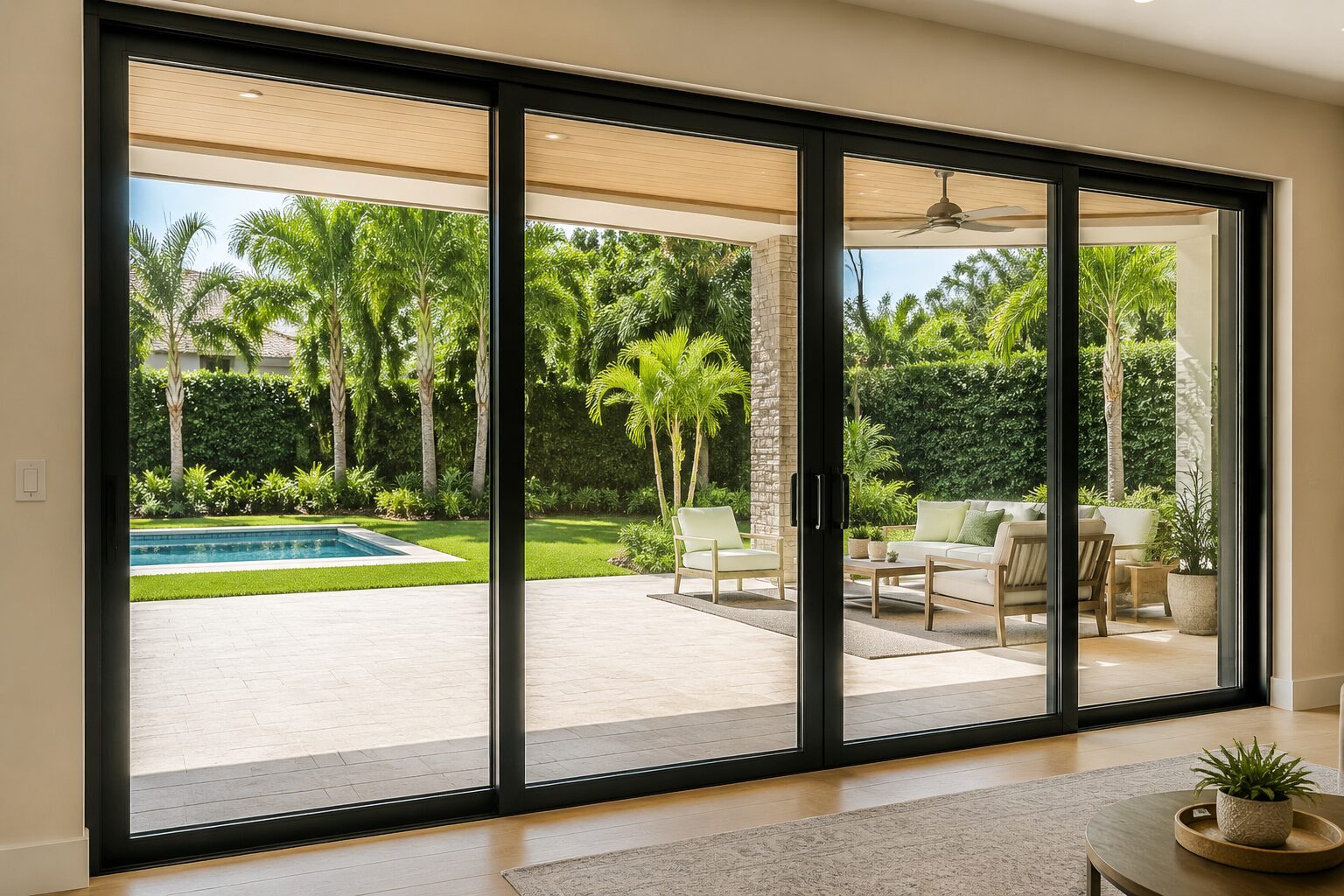
A door that opens partway and then stops is not necessarily suffering from the same fault as a door that is heavy from the first movement. The location of the stop may correspond to something on the track, behind the moving panel, at the handle or within an accessory arrangement.
Before deciding how far the door should open, identify its intended configuration. Some systems have designed travel limits. Others may have a security accessory or a pet insert that changes the usable opening. Removing a stop without understanding its purpose can create a different problem.
The most useful investigation follows the panel’s travel rather than focusing only on the lower rail. For a stable door with intact glass, you can document that route without lifting the panel or dismantling fixed hardware.
First ask whether the available opening changed
Did the door previously open farther under the same configuration? If so, when did that change? A new obstruction or altered component is more likely to be relevant than a limit that has always existed as part of the design.
If you recently moved into the home, look for product information and ask about installed accessories before declaring the panel broken. In a Phoenix property with several patio configurations, one opening may operate differently from another even when both appear to be ordinary sliders.
Record the usable opening without standing in the path or forcing the panel farther. A photograph from the room showing the stopped position, the fixed panel and the surrounding furniture often explains more than a close-up of the handle alone.
Walk the travel path with the panel stationary
Look for furniture, a chair cushion, a curtain, a loose cord or another object contacting the handle or panel. A projection can hit something before the wheels reach the suspected bad area on the rail.
Move ordinary loose objects away from the path. Do not remove installed hardware, security devices or stops whose function is unknown. Identify an accessory and consult its instructions before changing how it limits movement.
Check the exterior side from safe, ordinary access if available. A panel can contact an object behind the fixed glazing where the indoor observer cannot see it clearly. Do not lean out, climb or reach through a narrow gap to investigate the hidden side.
Distinguish a stop from increasing resistance
An abrupt, repeatable stop suggests physical interference, while gradually increasing drag may suggest rubbing or an uneven running path. The distinction helps organize the inspection but does not identify the exact part remotely.
Observe whether the point stays the same and whether it changes when opening versus closing. Do not build up speed to cross it. A door that can be forced farther may be riding over a defect or pushing against a required component.
Pella’s owner guidance treats non-smooth patio-door operation as a condition with several possible causes.[1] That is a better starting assumption than assigning every restricted opening to dirty wheels. A clear description can narrow the possibilities without pretending the symptom alone is conclusive.
Check the exposed rail, gently
Vacuum loose material and inspect the accessible running surface. A small object, raised repair edge or deformed area can restrict travel. If you find a loose particle, remove it without reaching under the panel and compare the result using ordinary movement.
If the surface appears damaged, photograph it rather than hammering, filing or gluing it. Repair-track products exist for specified applications, but their fit and support need verification.[2] Covering a bad area is a proposed repair method, not a universal response to any halfway stop.
If no lower defect is visible, do not assume the track is cleared of suspicion. The wheel contact area can be partly hidden. At the same time, continue checking upper and side contact so an unrelated obstruction is not missed by focusing exclusively on the sill.
Look for contact above and beside the moving panel
A folded seal, displaced guide or contact at a meeting stile can become significant only after the panel reaches a certain position. A handle or newly fitted lock component may also contact another surface as panels overlap.
Photograph visible rub marks and any component that changes position during ordinary movement. Do not place a finger at the contact point to feel it happen. If the evidence cannot be obtained without reaching into a pinch area, leave that part to controlled service.
Mention any recent handle replacement, roller adjustment or weatherstrip work. A component can function at the closed position yet interfere farther along the travel. Full-travel verification is therefore important after repair, not only a check that the door opens a few inches.
Treat travel-limiting hardware deliberately
Some devices restrict the opening intentionally. Others retain, guide or protect the panel. Their physical simplicity does not mean they are optional. A short screw or block may have a defined role in that product configuration.
Manufacturer guidance cautions against unsupported product modifications.[3] Before removing or relocating a fixed component, establish what the manufacturer permits and what effect the change would have on operation and retention.
If the owner wants a wider usable opening, that is a separate request from repairing a new fault. Ask whether the existing configuration can provide it without an unsupported alteration. The answer should reflect the identified door, rather than a promise that any slider can be made to travel farther.
Consider the screen independently
A screen left partly open can contact another component or make the patio seem blocked when the glass panel is working. Test each stable panel separately using ordinary operation. Do not assume the lighter screen and the heavy door share the same support hardware.
If the screen is the restriction, the screen-door guide addresses its rails, rollers or hanging arrangement. If both panels stop at the same apparent location, document that carefully; shared visible context does not prove a shared mechanical fault.
Keeping the systems separate also helps with parts identification. A photograph of a screen wheel is not a substitute for identifying the glazed-door assembly, and a glass-door roller kit is not an appropriate default screen repair.
Prepare a focused service request
Report the former opening distance, the present stopping position, whether the stop is abrupt or progressive and what changed before it began. Include an overall image and close-ups of visible contact, labels and accessories.
The technician should explain what limits travel and whether that limit is intended or defective. If repair is needed, ask how the proposed work restores the intended range while retaining required components and normal closing function.
Do not accept a demonstration that uses more force than normal operation. After the work, the panel should complete its intended travel in a controlled way, return to the closing position and operate its lock as designed. A wider opening that creates a new locking or stability problem is incomplete work.
Common questions
Can a single bad spot stop the whole door?
Yes, a localized obstruction or damaged running surface can restrict travel. Other contact points can produce the same symptom, so the actual interference should be identified before choosing a track repair.
Why does the door stop at different places on different days?
Loose objects, moving seals, contamination or changing contact conditions may be involved. Record the variations instead of forcing them into one diagnosis. A short observation log is useful when a fault is intermittent.
Is the stop screw safe to remove?
Not until its purpose is established for the identified product. It may perform a required travel, guide or retention function. Have the component evaluated rather than treating every visible limit as unwanted hardware.
Saguaro Sliding Doors provides sliding door repair in Phoenix and nearby communities. Call 602-560-4705 and explain that the door opens partway before stopping. Include any recent accessory or hardware change so the travel path can be assessed as a whole.