A sliding door’s sound can help locate a problem when it is paired with movement. The noise alone is less useful. A squeak does not automatically prove a dry bearing, and a grinding sound does not establish that the track must be replaced.
Listen for when the sound occurs: at the start, throughout travel, at one rail location or only while the panel seats and locks. That relationship can make a service request much more specific. It also helps avoid the common mistake of spraying the loudest area without finding the contact.
For a Phoenix patio, fresh dust may be part of the story. So may a worn assembly, a rubbing seal or a handle that is flexing under excessive force. Treat the sound as a clue to investigate, not a diagnosis that names its own replacement part.
Start with a safe recording
If the glazed panel is stable and intact, record one normal opening and closing sequence from a safe standing position. Capture the sound without putting the phone near a moving gap. Keep fingers away from the lower rail and meeting stiles.
Stop if the door jumps, rocks, produces a sharp breakage sound or needs substantial force. You do not need a perfect recording to arrange inspection. A description of the event and the panel’s current position is more important than reproducing a potentially unstable condition.
Note whether the sound is new and whether its timing changed. A once-quiet door that suddenly clicks after service tells a different story from an older panel that has gradually become rough. Include recent cleaning, repairs and accessories in the record.
Match the sound with the part of travel
| Sound and timing | Useful inspection direction |
|---|---|
| Sandy scraping after visible contamination | Accessible debris and contact surfaces |
| Repeating click or thump during movement | Rotating components and recurring contact |
| A bump at one fixed place | Local rail defect, joint or obstruction |
| Squeak only when pulling the handle | Handle attachment and overall operating resistance |
| Rub or pop near final closure | Seals, interlock, alignment and locking relationship |
These directions can overlap. A worn wheel can meet a bad section of rail, and a loose handle can coexist with a rubbing panel. The purpose of the table is to organize observation, not to turn a sound into a remote parts order.
A sandy scrape: begin with accessible contamination
Vacuum loose grit and wipe exposed surfaces according to the manufacturer’s care instructions. Work without lifting the panel or pushing tools beneath it. If ordinary movement improves, record what changed and whether any resistance remains.
If the sound returns immediately, contamination may remain in inaccessible areas or a mechanical contact may be producing the sensation. Do not keep adding cleaner until the track looks polished. Fresh material after each pass can itself be evidence of unwanted rubbing.
The Phoenix track-cleaning guide provides a controlled sequence. Cleaning is a sensible comparison, but it should not become a ritual that allows a steadily worsening door to remain undiagnosed.
A repeating click: compare distance and location
A sound that repeats as the panel moves can justify checking the wheel assemblies and their contact. A sound that occurs only at the same physical location on the sill draws attention to a local feature. Record the pattern without marking the running surface.
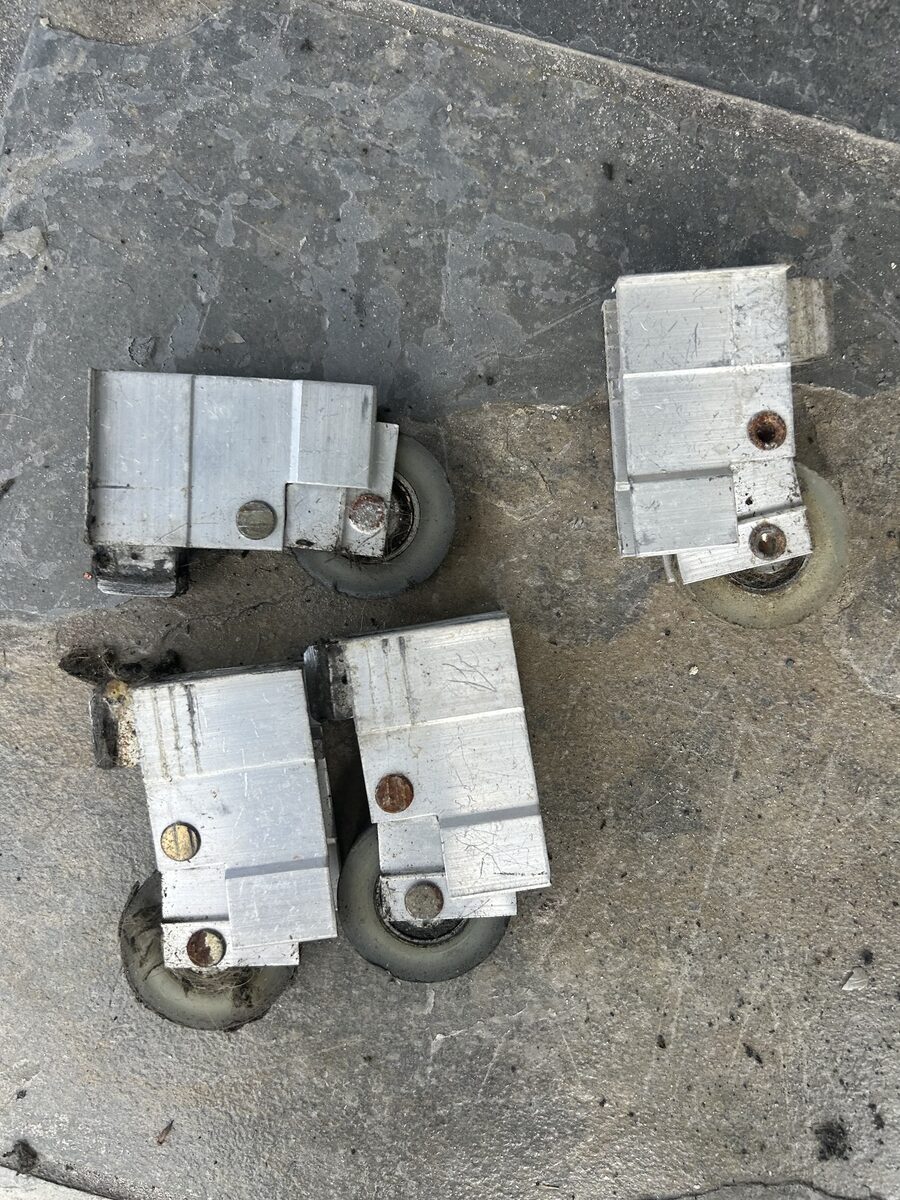
Roller assemblies differ in wheel arrangement and construction.[1] The technician needs the identified system and actual hardware condition, not merely an audio description. A repeating sound could also come from another moving or contacting component.
If clicking is accompanied by rocking, loss of position or visible damage, stop operating the panel. The guide to a door that jumps or wobbles takes priority over further sound-based comparison.
A fixed bump: inspect the running path
With the panel stationary, photograph the exposed area associated with the bump. Look for debris, a deformed rail or a repair edge without probing it with metal tools. If the area is hidden, leave controlled access to service.
Manufactured repair tracks are available in defined profiles and lengths.[2] Whether one suits a defect depends on the underlying support, fit and effect on operating height. The existence of a repair product does not establish that a cap is the right answer for your door.
Ask what is contacting at the bump and how the proposed work restores a suitable path. A panel that crosses the location only when pushed quickly still has a fault. Momentum should not be the final operating method after repair.
A squeak: identify the surface before lubricating
A squeak can originate at a seal, handle attachment or other contact point. Listen to when it occurs and inspect visible marks. Spraying everything can quiet one surface temporarily while making the actual source harder to distinguish.
Andersen specifies cleaning and appropriate lubricant use for its hardware, including restrictions on incompatible products.[3] Follow the instructions for your identified model and component. The correct treatment for a lock mechanism is not automatically the correct treatment for a running rail or screen guide.
If the noise is caused by missing clearance, lubrication cannot restore that clearance. The sound may change while the unintended contact remains. Describe the operating resistance alongside the sound so the inspection addresses function rather than silence alone.
A final-closing pop or rub: watch the meeting parts
A door that sounds normal until the last part of closure may be contacting a seal, interlock or receiver incorrectly. Photograph displaced weatherstrip or an uneven approach with the panel stationary. Do not use the locking control to force the parts together.
Check whether the sound began after seal replacement or roller adjustment. Those changes can affect the closing relationship. A repair that improved travel may still need a final closing-system correction.
The article on a door that will not close the last inch explains that phase separately. The practical goal is a panel that travels, seats and secures normally, not a door that can be made quiet while remaining difficult to close.
Keep environmental context specific
For a Phoenix opening, note a recent dust event, sprinkler overspray or afternoon-only binding. Do not assume all noise comes from the desert climate. A newly fitted wrong part can produce a sound regardless of weather, while contamination can make an existing fault more obvious.
If the sound changes after safe cleaning, record the before-and-after result. If it changes naturally with the time of day, document that pattern without heating or cooling the panel experimentally. Consistent observations help a technician evaluate an intermittent complaint.
Keep the recording and service description after repair. They provide a comparison if a new noise develops later and reduce the temptation to treat every sound with another product. A different noise at a different point may be a separate condition.
Questions to bring to the service visit
Ask what component creates the sound, whether it indicates wear or interference and whether the door’s support is sound. Ask how the proposed work will be checked through the full travel and closing cycle.
If parts are recommended, request their identification and compatibility explanation. If only maintenance is proposed, ask what condition was inspected and what change should be expected. The answer should connect the work to the symptom rather than promise that every old door can become silent.
Is a noisy door always unsafe?
Not every sound indicates immediate instability, but noise combined with jumping, damaged glass, loss of control or a displaced panel calls for stopping use. Persistent grinding or increasing force also deserves inspection rather than repeated forceful operation.
Can I diagnose a bearing from a video?
A recording helps show timing and character. It cannot establish all the hidden component conditions or rule out another contact. Use it to support an inspection, not as conclusive proof of one replacement part.
Saguaro Sliding Doors offers sliding door repair, roller replacement and track repair in Phoenix. Call 602-560-4705 and describe where in the travel the noise occurs, not just what it sounds like.