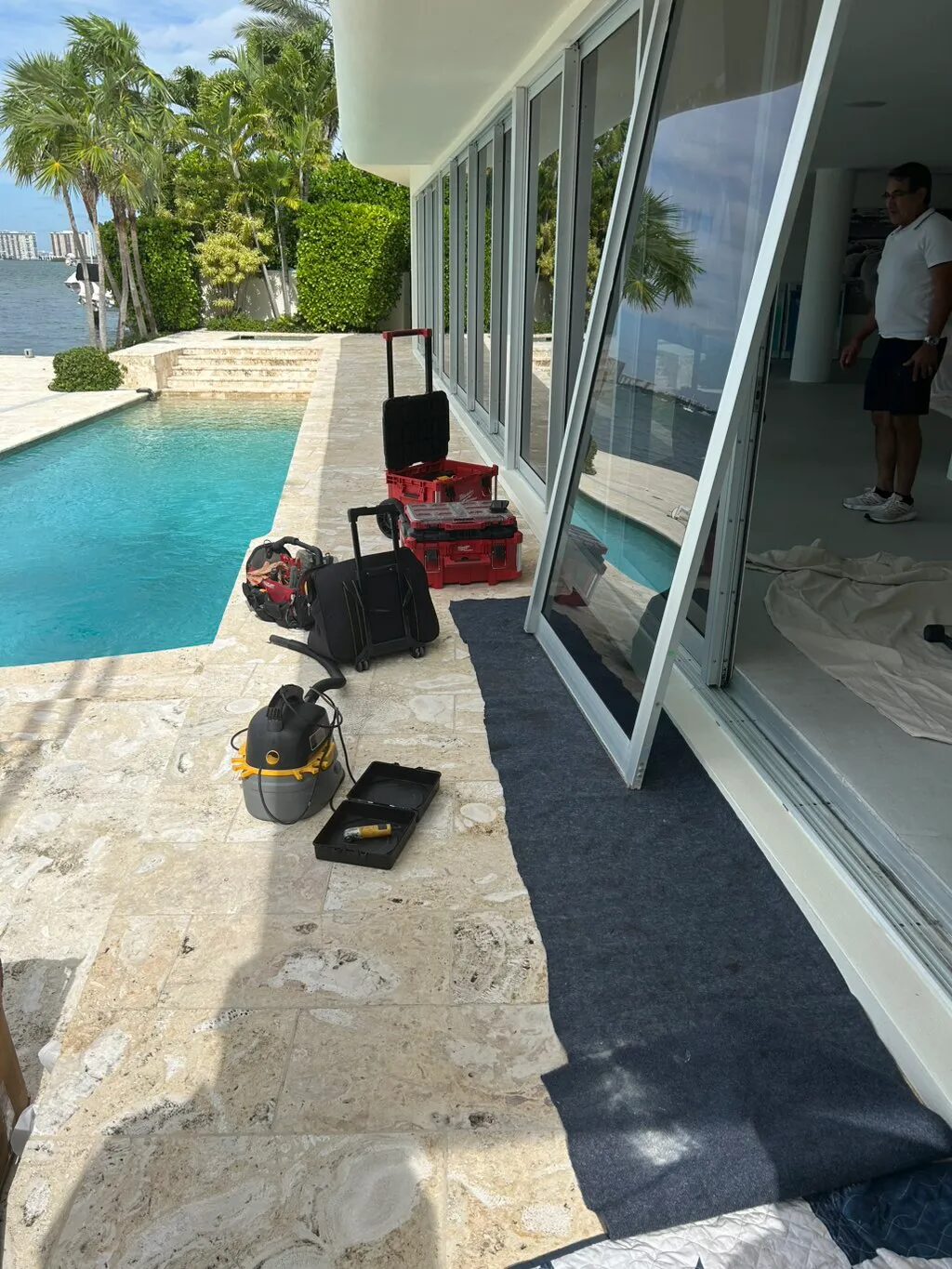
A manual sliding door in a business should not require staff to drag it, lift it by the pull or recruit a second person for every opening. Increasing effort can indicate contamination, damaged support hardware, interference or a problem with the installed assembly.
Begin by identifying the system. A manually operated glazed entrance, a sliding wall and a powered automatic entrance have different support, control and inspection requirements. A residential patio-door adjustment video is not a universal service procedure for commercial equipment.
For a Phoenix business, the practical impact may be interrupted deliveries, restricted patio access or staff using awkward workarounds. The service plan should address the actual movement fault while keeping the opening and pedestrian route appropriately managed.
Confirm whether the system is truly manual
Look for a powered header, function switch, activation device or manufacturer information indicating automatic operation. Do not disconnect power and assume the equipment can then be treated as a simple manual slider. Its intended operating arrangement still matters.
If it is powered and malfunctioning, use the automatic-door guide and arrange qualified service. Do not pull against a drive mechanism or force panels that are intended to move under operator control.
For a manual system, identify whether it is a single sliding panel, a multi-panel arrangement or a sliding wall with a defined sequence. NanaWall’s single-track system manual, for example, requires a product-specific operating sequence and cautions against forcing a malfunctioning system.[1]
Describe the work interruption precisely
State whether the panel is heavy everywhere, stops at one place, cannot complete closure or cannot release its locking points. Record whether the complaint is constant or appears after particular use, weather or cleaning.
Also note who operates it and how often. An opening used occasionally for a patio and one repeatedly used during business hours can have different inspection and scheduling needs. Do not turn an approximate use description into a fabricated cycle count.
Tell the service provider whether the door is part of an important access route, is currently unsecured or has visible damage. Temporary arrangements should be planned for the actual premises and occupants, with relevant facility professionals where needed. Keep the report factual rather than assuming a generic solution meets every site requirement.
Follow the support path
Some manual systems run on lower hardware; others carry panels from above. The visible bottom guide may not be the primary support. Identification is essential before assigning a failed bottom roller or deciding where adjustment belongs.
The inspection should consider the panel, its support assemblies, the running or hanging path, guides and required retention. A loose guide can affect control without being the component that carries the weight. A distorted support can make otherwise serviceable hardware bind.
Ask the technician to explain which part is responsible for the observed resistance. A clear answer connects the support arrangement with the symptom. “Commercial doors are heavy” is not an adequate reason for an opening that no longer moves normally.
Check accessible contamination without disrupting traffic
Restrict use of the affected area as appropriate before cleaning. Vacuum loose accessible material only under the identified owner instructions and without placing tools beneath a panel or between moving edges. Do not have one employee push while another reaches into the track.
Phoenix dust, landscaping debris and frequent foot traffic can all be relevant to what accumulates at an opening. A cleaning observation should still distinguish loose dirt from fresh material produced by rubbing or wear.
If safe cleaning does not restore normal movement, stop escalating the treatment. A rail, guide or support fault needs inspection. Do not make repeated lubrication the unofficial staff procedure for getting through a busy shift.
Review the operating sequence with staff
Multi-panel manual systems may have specific locking points and panel order. Ask whether staff were shown the intended procedure and whether the current workaround differs from it. A missing operation step can resemble a jam, while an actual fault can tempt people to invent a new sequence.
Manufacturer maintenance guidance emphasizes correct operation and prompt attention to binding or damaged components.[2] Training should therefore explain normal use and when to stop, not teach staff to overcome resistance with extra force.
If the procedure is unknown, request a demonstration for the identified system after the repair. Keep a short, accurate operating note available to the people who use it. Do not publish guessed instructions based only on the direction the panels appear able to move.
Inspect the whole travel and the closing condition
A door can open more easily after adjustment yet still fail to close or secure. Check the point where it meets its jamb or neighboring panel and whether seals or locking points interfere. Record each failed stage separately.
If resistance occurs only in the final travel, it may not be a rolling-hardware problem. If it occurs at one fixed point, inspect the local path. If it changes as panels stack, evaluate the relationship between panels rather than only the first operating leaf.
The multi-panel guide provides a useful observation method. For a commercial installation, the actual manufacturer instructions and site conditions still determine the permitted repair and final checks.
Recent work can change the diagnosis
New flooring, a replacement handle, a track repair or a relocated lock can introduce contact where none existed before. Ask staff when the first change was noticed and compare it with service and maintenance records.
Do not assume a newly installed part is correct because it can be attached. Hardware fit, finished panel position and travel clearance need verification. Likewise, do not assume all previous work was wrong; a separate older condition may remain outside that scope.
Manufacturer support resources can help identify the correct system and service information.[3] Keep model and project details available so the service visit can begin with the actual product rather than another visual guess.
Define a repair that can be evaluated
A useful scope identifies the movement fault, the affected components and the intended correction. It should distinguish commercial sliding door repair, parts sourcing, any frame or support work and the final operation review.
If the provider cannot establish a hidden condition until controlled access, ask how that uncertainty will be handled. Discuss how the opening will be secured or protected if the correct part is not immediately available. Avoid forcing a merely similar component into the system to meet an unsupported timing promise.
Request the actual product and workmanship terms offered. Do not infer certification, manufacturer authorization or a warranty from the fact that a company services sliding doors. Those details should be stated and verified when relevant to the work.
Handover matters as much as easier movement
Have the technician demonstrate the complete normal sequence, including closing and securing the opening. Ask a regular staff member to repeat the procedure with guidance. The repair should not depend on a special maneuver known only to the installer.
Keep the findings, part information and maintenance recommendations in the facility record. Record any condition that remains outside the completed work. A clear handover helps staff report a new symptom without restarting the same trial-and-error process.
Should employees keep helping the door by lifting it?
No. Lifting at a pull or pushing in groups is a workaround that can conceal a support or contact fault. Stop forcing the opening and arrange inspection with an appropriate access plan for the business.
Does a manual door need the same checks as an automatic one?
The systems have different requirements. Identify the equipment and follow its applicable instructions. Do not apply an automatic-door control procedure to a manual system or assume a powered door becomes manual equipment when switched off.
For commercial sliding door repair in Phoenix and surrounding communities, call Saguaro Sliding Doors at 602-560-4705. Include the system type, current position and the stage where ordinary operation fails.