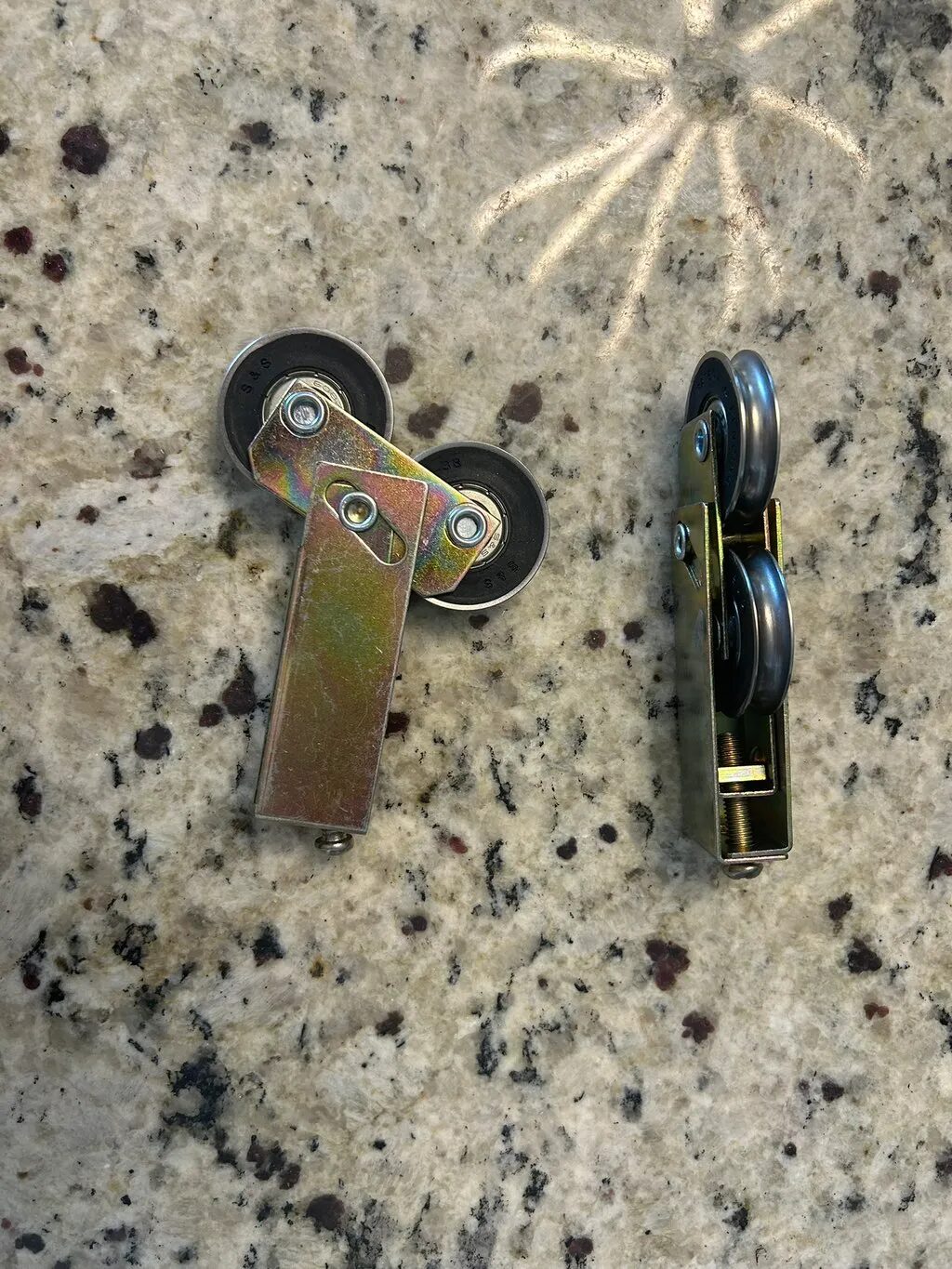
You expected an easier door after roller replacement. Instead, the panel is still heavy, catches at one point or now refuses to close properly. The right response is to describe the remaining fault precisely and review the completed system, rather than assume the new parts simply need to “break in.”
A roller replacement changes one part of the movement path. The existing rail, panel clearances, frame geometry, seals and locking relationship still matter. The replacement itself also needs to be compatible and correctly positioned.
For a Phoenix homeowner, this is a useful time to compare before-and-after behavior. Did the grinding disappear but a final-inch obstruction remain? Did a lower scrape become an upper scrape? Those differences can show what the work accomplished and what still needs attention.
Question one: what improved, and what did not?
Separate the symptoms instead of describing the entire repair as successful or unsuccessful. Record the rolling effort, sound, contact location, closing position and latch operation. A change in one does not establish the condition of the others.
If the panel is stable, use ordinary movement for a short comparison. Do not lift it by the handle or push through a hard stop. If it now wobbles or appears displaced, stop operating it and report that promptly.
A useful report might say: “The door no longer grinds through most of its travel, but still catches near the middle and will not latch without lifting.” That directs attention toward several remaining relationships without claiming to know which replacement part is wrong.
Question two: how were the assemblies matched?
Roller catalogs show different housings, wheel profiles, mounting styles and adjustment arrangements.[1] Matching therefore requires more than finding a wheel with the same approximate diameter or choosing a product described as heavy duty.
Ask for the installed part description and the basis for compatibility. The existing manufacturer information, original hardware and operating requirements may all be relevant. A door with an unclear repair history can require more identification work than its appearance suggests.
Do not remove the new assemblies yourself to compare them with an online picture. Controlled panel handling is part of the service. Start with the invoice, accessible labels and photographs of the completed opening, then ask the installer to review any uncertainty.
Question three: what condition was the rail in?
New wheels cannot make every old running surface smooth. A dent, flattened profile, rough transition or unstable sill can remain after replacement. Ask whether the contact surface was inspected and whether any defect was documented.
Track covers are manufactured for certain repair applications.[2] That does not mean one should automatically be added after every roller job. The underlying condition, profile and finished height need to support the proposed method.
If a track repair was also performed, ask how its effect on panel position was handled. The relationship between new wheels and a changed running surface should be checked together. Replacing either component in isolation can leave an unsuitable contact or clearance condition unresolved.
Question four: was the panel set in its intended position?
A door can roll more easily and still be tilted. It can clear the sill yet rub the header. It can travel smoothly but stop with the latch misaligned. These are reasons to verify final position rather than judge the repair from a short opening movement.
Manufacturer adjustment guidance connects panel position with the closing relationship on identified models.[3] The service should follow the correct product procedure and confirm the result across the opening. A generic number of screw turns is not a meaningful final standard.
Ask whether sufficient adjustment range remains and whether all required retention pieces are in place. If the assemblies cannot position the panel correctly without exhausting the range, that deserves explanation. More force at the adjuster is not the same as a suitable hardware match.
Question five: is the remaining fault actually at closure?
If the panel travels well until the last distance, inspect the closing edge, interlock, weatherstrip and receiver. A separate final-inch problem can remain even when the roller work was appropriate. The diagnosis should not stop at “new rollers installed.”
Describe any bunched seal or contact point you can see without dismantling. If the lock requires a lift or shove, record that operation. Do not keep using the latch to force the panel through a restriction while waiting for the installer to return.
The guide to a door that will not close the last inch explains that phase of travel. If the door seats normally but will not secure, use the closing-but-not-locking guide to describe the remaining issue.
Question six: was another condition outside the agreed scope?
A service description may identify roller replacement while documenting a frame or rail issue that remains. Read that scope carefully. A targeted repair can be useful without resolving every condition in an older opening, but the limits should be clear.
Ask the provider to distinguish completed work, confirmed additional faults and conditions still requiring investigation. This makes it easier to compare a further repair with replacement and prevents an uncertain observation from being presented as a definite conclusion.
If a second opinion is needed, share the actual part information and findings. Do not ask the next technician to work only from “someone changed the wheels.” The previous record can reduce duplicate identification and help explain how the symptoms changed.
Avoid three unhelpful experiments
First, do not add several lubricants to see whether the door can be made temporarily quiet. That changes the condition and may create residue without resolving geometry. Record any product already used so the inspection can account for it.
Second, do not independently readjust every visible screw between service visits. Changing multiple settings makes it harder to compare outcomes. If the manufacturer procedure is not clearly identified and appropriate for you, leave adjustment to the provider reviewing the work.
Third, do not accept increasing force as a normal adaptation to new hardware. A sound repair should have a defined operating result. If special movement is required, ask why and whether it indicates an unresolved fault or a feature of the identified design.
Include Phoenix operating conditions in the recheck
If the complaint is worse in afternoon sun or after dust exposure, explain the timing and supply a safe recording. The installer may need to compare natural operating conditions rather than evaluate only a short morning demonstration.
Keep the description accurate: heavy all day, worse later; smooth until the jamb; or rough only at one fixed point. Local climate provides context, while the observed contact and component condition determine the repair.
After the review, keep an updated record of what changed and the final normal-operation check. A precise service history is useful for future parts selection and helps keep a repeated symptom from becoming another round of unstructured adjustments.
Do new rollers need a week to become easy?
Do not rely on that explanation for unexplained binding, scraping or instability. Ask the installer what the identified product requires and what evidence supports normal operation. A remaining mechanical interference deserves review.
Does continued sticking prove the new rollers are defective?
No. Rail condition, alignment, seals or another fault can remain. The assemblies themselves also need verification. A focused inspection should establish the cause rather than automatically replacing the same parts again.
Should I now replace the whole door?
Only after comparing the remaining condition, compatible repair options and the complete replacement scope. An unresolved symptom after one intervention does not by itself establish that all further repair is impractical.
Call Saguaro Sliding Doors at 602-560-4705 for sliding door repair in Phoenix. Include your previous service description, the installed part information if available and the exact symptom that remains.