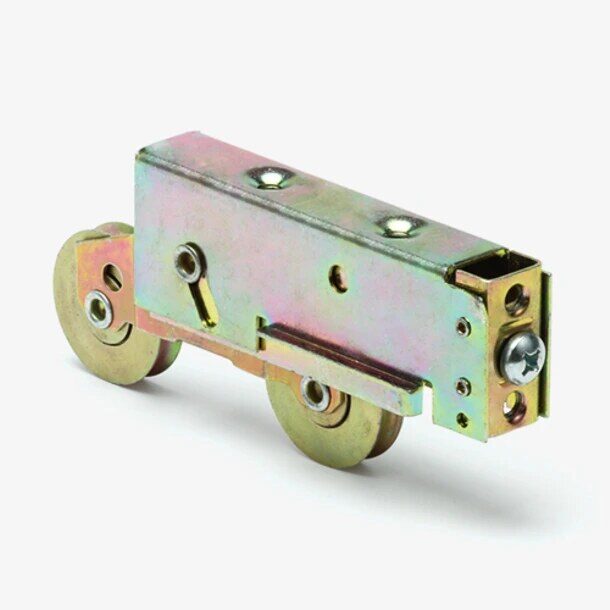
An impressive material description cannot make an incompatible part work correctly. A stainless-steel roller with the wrong housing or wheel profile may leave a door heavy, too high or unable to close. A neatly fitted repair track can still be unsuitable if its support or finished height is wrong.
The useful question is not simply whether a component is stronger than the old one. It is whether the complete replacement suits the identified door and restores its intended operation. Material, dimensions, load suitability and installation all belong in that decision.
Saguaro Sliding Doors imports sliding-door parts, including roller, custom-fit track and stainless-steel options where appropriate. Those options should be explained through the actual application, with no assumption that one material or assembly is correct for every Phoenix patio.
Begin with identification
Collect accessible manufacturer labels, product markings and previous service records. Photograph the complete opening and the affected component where safely visible. Do not remove a heavy panel to supply a hidden part number before the service plan is established.
A house’s construction date is not always the door’s manufacturing date, and a glass pane may have been replaced separately. Several clues may therefore be needed. The original component can be documented during controlled access if identification cannot be completed from labels.
An unknown brand does not automatically make repair impossible. It does mean the provider should explain how compatibility will be verified and what uncertainty remains. Avoid accepting a confident parts promise based only on the color of the frame or the apparent size of the wheel.
Match the roller assembly, not only the wheel
Parts catalogs show different housings, mounting arrangements, wheel sizes and configurations.[1] These dimensions determine how the panel is supported and positioned, not merely whether the replacement wheel can turn.
Ask how the housing fits, how it attaches, whether the wheel profile suits the rail and whether the adjustment range can produce the intended panel position. Load suitability and the product instructions must also be considered for the actual panel.
Replacing a wheel inside a damaged housing may leave failed adjustment threads or attachment problems. Conversely, replacing an entire assembly without checking its geometry can create new interference. The proposed scope should name the part and explain why that level of replacement is appropriate.
Understand what “stainless steel” describes
Stainless-steel roller assemblies are offered for particular applications, including exposure where corrosion is a concern.[2] Ask which components are stainless and what the actual product specification provides. A stainless housing does not automatically describe every bearing, fastener or connected part.
Do not assume a steel grade, country of manufacture, rustproof guarantee or service life that has not been supplied. The right discussion is about the identified product and exposure, not an unsupported promise that stainless parts never need maintenance.
For a Phoenix patio near irrigation or poolside activity, describe the actual wetting and cleaning conditions. That history can inform selection. A dry, sheltered opening and a repeatedly wetted one should not automatically receive the same material recommendation merely because both are in the same city.
Material compatibility includes adjoining parts
Dissimilar-metal corrosion depends on conditions including electrical contact, sufficiently different metal behavior and a conductive liquid. The Australian Stainless Steel Development Association explains those requirements in its technical guidance.[3]
That does not mean every stainless-to-aluminum contact will fail or that Phoenix patios should avoid stainless components. It means the assembly, exposure and product design need to be considered together. A material label alone cannot establish suitability.
Ask the provider how the proposed part works with the existing rail, housing or attachment. Do not add insulating layers, coatings or sealants as a home experiment. Any required interface treatment should follow an appropriate identified design rather than an improvised response to a general corrosion warning.
Define what custom-fit track work means
“Custom-fit” should describe how the proposed component is selected or prepared for the actual opening. It should not be a vague synonym for premium. Ask for the relevant profile, length, support and finished running-surface relationship.
Manufactured repair covers exist for certain patio-door tracks.[4] They illustrate one possible method, not a universal substitute for a damaged sill. A cover requires an appropriate underlying rail and must not conceal a moving, distorted or otherwise unsuitable base assembly.
If a new surface changes the wheel’s running height, the panel position and closing system need rechecking. Ask how transitions, edges, drainage and required clearances will be handled. A visually neat strip is not the only test of a functioning repair.
Compare the part with the symptom
If the panel is heavy throughout travel, ask whether the support assemblies turn and position it properly. If it catches at one location, ask what happens at that point on the running path. If it rolls well but will not close, ask about the final meeting relationship.
This symptom-first discussion prevents a parts catalog from driving the diagnosis. An available stainless roller is not automatically the answer to a folded seal, and a track cover is not automatically the answer to a disconnected lock control.
The guides to worn rollers and fixed track stops explain those inspections separately. A complete repair can involve both, but each proposed component should have a stated reason.
Ask about availability without demanding a fictional promise
Some components may be stocked; others may need identification or sourcing. Ask what is confirmed, what must be measured after controlled access and how the opening will be managed if the correct part is not immediately available.
No honest provider can guarantee every unknown door has an instant compatible part. A clear sourcing plan is more useful than fitting a merely similar assembly to avoid a second visit. The owner should understand timing and scope before the door is taken apart.
Request the actual product and workmanship terms offered. Do not assume an imported component or stainless option carries a particular warranty. Keep the part description so later service does not start again with guesswork.
Verify the installed system, not the packaging
The final demonstration should include controlled movement through the intended travel, appropriate clearance, ordinary closure and locking. Check the location where the original resistance occurred, including any natural timing pattern such as afternoon binding.
Ask which parts remained in service and what maintenance they require. A repair may restore operation while documenting another condition for future attention. That limit should be explicit rather than hidden behind a premium material description.
Keep before-and-after photographs and the component record. If another technician services the door later, identification and the repair history can prevent mismatched replacements and unnecessary duplicate work.
Are tandem rollers always better than single wheels?
Not as a universal rule. The configuration must suit the panel, mounting, rail and product requirements. More wheels do not automatically create a compatible assembly or correct an unsuitable running surface.
Does custom fit mean the entire sill will be replaced?
Not necessarily. Ask what exact component and preparation the term describes. A repair cover, replacement track section and broader sill intervention are different scopes with different suitability questions.
Can stainless parts still need maintenance?
Yes. Material selection does not eliminate contamination, wear, alignment or the need to follow care instructions. Ask about the actual component rather than accepting a general maintenance-free claim.
For roller replacement and sliding door track repair in Phoenix, call Saguaro Sliding Doors at 602-560-4705. Send available labels and describe the movement fault so parts selection can serve the diagnosis.